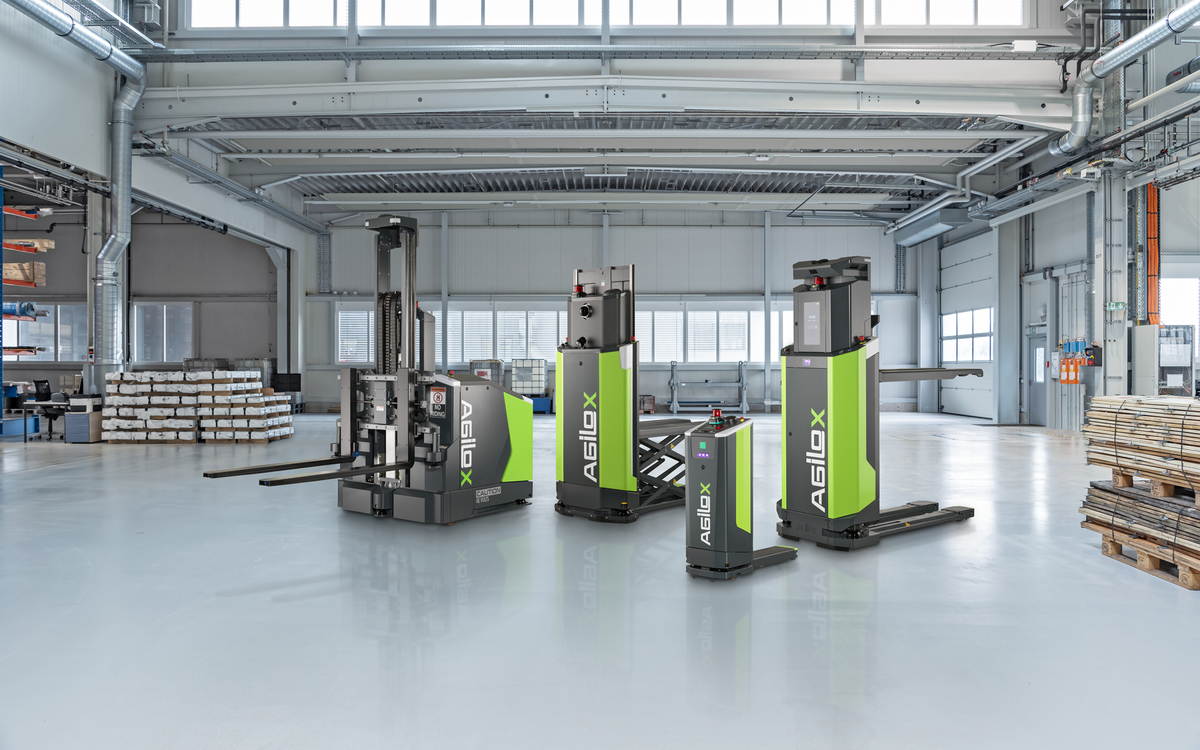
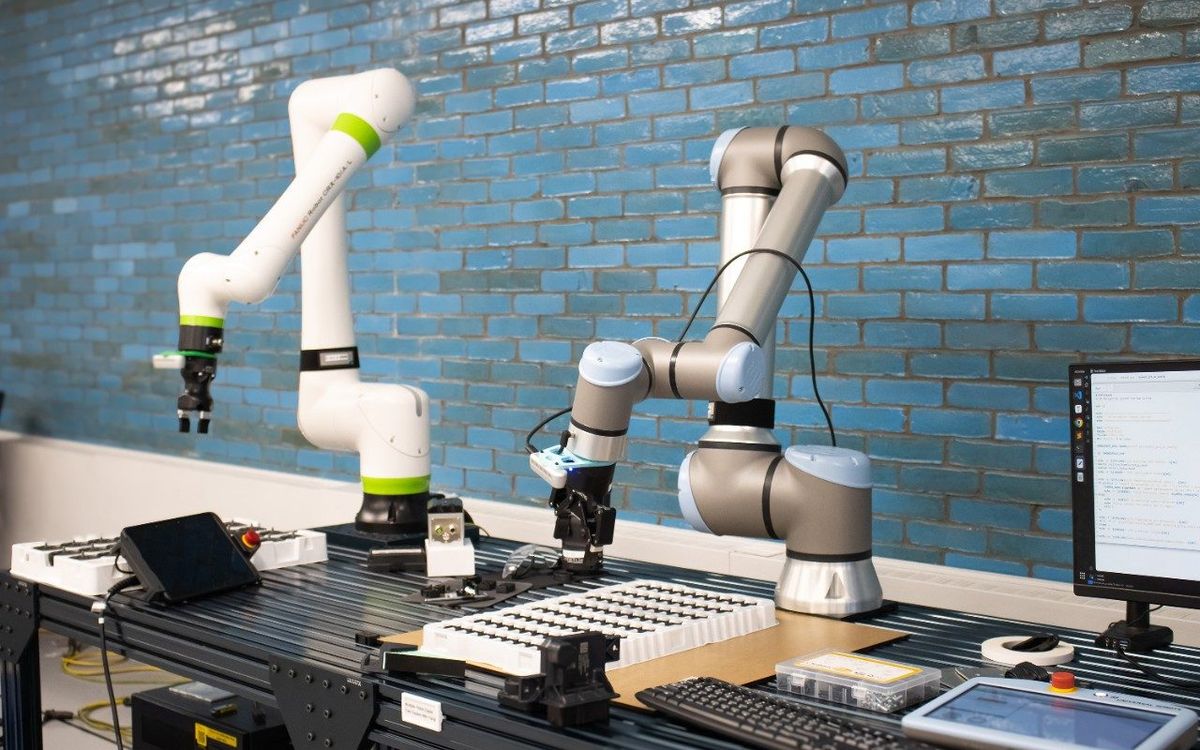
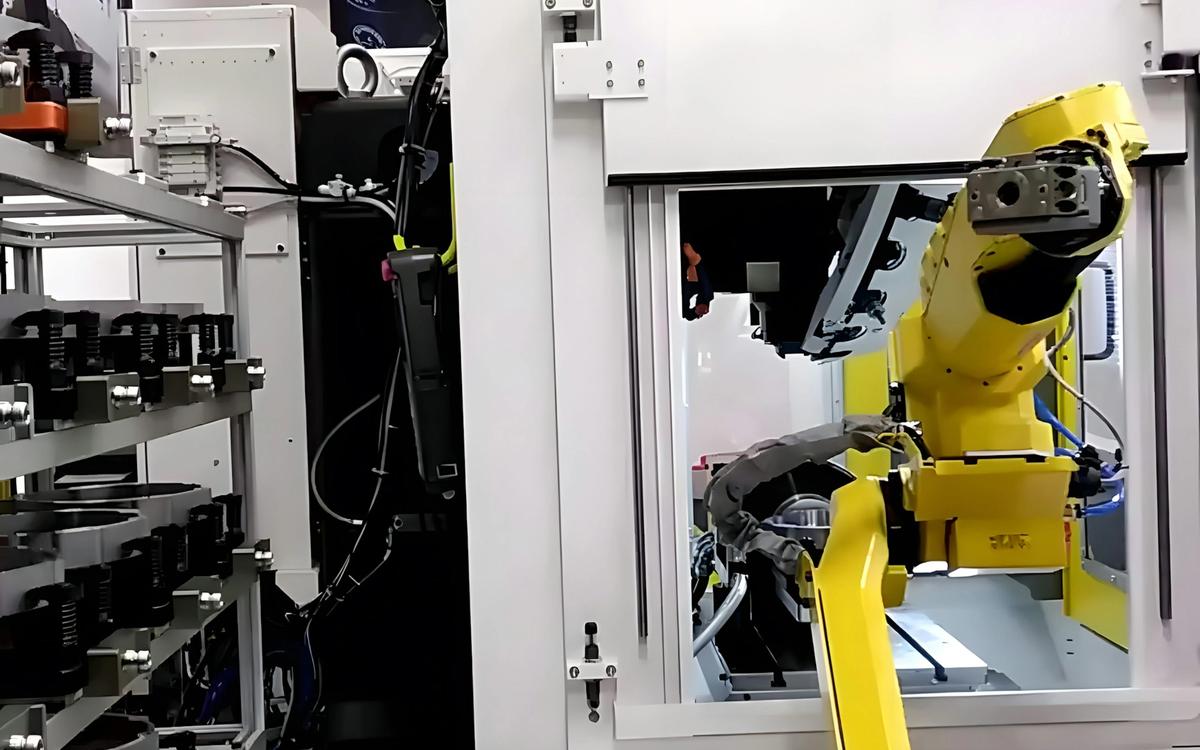
Physical AI is artificial intelligence that senses the physical world and acts in it through machines, rather than producing only text or images. NVIDIA’s glossary says physical AI “enables autonomous machines, such as robots in factories and robotaxis, to perceive, understand, and perform complex actions in the physical world.”
In a machine shop, that means AI connected to cameras, robots, servo data and the CNC control itself. This guide explains what the term covers, which shop-floor applications are close to production in late 2026, which are still demonstrations, and what to ask a supplier before buying.
The short version
- Physical AI is AI that perceives and acts through hardware. A chatbot that writes G-code is not physical AI; a robot that finds an unfamiliar part and loads it into a lathe is.
- Robot vision is the most mature application. FANUC plans to ship AI Masterless Vision, which picks parts without part-by-part teaching, from January 2027.
- In CNC controls, AI currently proposes changes and a person approves them. FANUC’s Physical AI CNC checks each proposal in a digital twin first.
- Humanoid robots working beside machine tools are at the prototype stage, with no published production uptime.
- North American robot orders rose 24.8% year on year in Q3 2026, according to A3, with metals customers up 37.0%.
Physical AI is AI that senses and moves, not just answers
IBM’s definition is the simplest: physical AI “refers to artificial intelligence (AI) systems that operate in and interact with the physical world.” IBM separates it from robotics, which it describes as the mechanics and control of machines. Physical AI adds models that perceive, decide and learn from outcomes.
The practical difference shows up in how a cell is set up. A conventional robot cell is engineered for known parts and known positions, and every exception has to be programmed in advance. A physical-AI cell is meant to cope with some variation by itself.
| Task | Conventional automation | Physical-AI approach |
|---|---|---|
| Recognizing a new part | Register its image and teach each pick | Identify it from a general description, such as “cylinder” |
| Changing a CNC program | A programmer edits and proves it out | AI proposes an edit, simulation checks it, an operator approves |
| Planning work around the machine | Fixed sequences and signal handshakes | A planner splits a plain-language instruction into robot and CNC tasks |
| Learning a manual job | A robot programmer writes the motions | The robot learns from an operator’s demonstrations |
Simulation is central to all of it. NVIDIA describes physically based virtual environments, often called digital twins, where systems are trained and tested on synthetic data before they touch real equipment. For a shop, that is also where a proposed motion can be checked for collisions before any metal is cut.
Robot vision is the application closest to production
Teaching a camera what each new workpiece looks like is one of the recurring costs of machine tending. FANUC and KUKA both announced ways to cut it in October 2026.
FANUC’s AI Masterless Vision responds to a general instruction, such as identifying a cylinder, and then locates cylindrical workpieces it has never seen. At JIMTOF in Tokyo it loaded and unloaded a demonstration lathe. FANUC says the AI copes with varying light and with some glossy, reflective and transparent parts, and lists January 2027 as the start of shipments.
KUKA’s iiQKA.AI Vision, announced on October 8, 2026, moves 2D and 3D recognition and grip-point calculation into KUKA’s own engineering software. Image processing runs on the KUKA AI Extension Platform, which is based on NVIDIA technology, instead of a separate industrial PC. KUKA lists bin picking, assembly, inspection and depalletizing as applications.
Neither company has published an independently measured pick-success rate by material or lighting. Recognizing a part is also only the first step: the cell still needs grippers, safe approach paths, machine signals and a recovery plan for a failed pick.
In the CNC control, AI proposes and the operator decides
FANUC describes Physical AI CNC as a link between the CNC, its Smart Digital Twin and generative AI. A Model Context Protocol (MCP) server gives AI applications controlled access to selected machine data and tools, such as alarms, servo information and the current NC program.
At JIMTOF 2026 FANUC showed three uses. A machining-surface tuner read servo data and the NC program, proposed changes to acceleration and deceleration to reduce visible machining marks, simulated them and produced an amended program. An alarm-diagnosis navigator suggested countermeasures for a CNC alarm. A third demonstration turned handwriting on a tablet into a laser engraving path.
In each case the operator approved the result before the machine ran it. That approval step matters more than the AI itself. A digital twin catches only what its model contains, and it cannot see a loose clamp, a broken tool or chips packed around a fixture.
FANUC has not announced when the combined system will be sold.
Humanoids at the machine are still demonstrations
Mitsubishi Electric is working on the jobs around the machine rather than the cutting. Its October 21, 2026 prototype combines an AI machining task planner, a CNC with a physical-AI interface and a general-purpose humanoid robot. An operator gives an instruction in plain language, and the planner divides the work between the machine and the robot. Setup, cleaning, part removal, transport, inspection and troubleshooting are the target tasks.
The CNC still controls the tool path. The humanoid handles the physical work around it, which is exactly the variable, awkward work that dedicated automation struggles to justify.
Embodied AI’s AIR, shown in Munich on November 6, takes a different route: a wheeled, two-armed robot with tendon-driven arms that give on contact. It learns tasks from operator demonstrations, and the company says a job can often move toward autonomous running within about a month. CE marking is planned for 2027.
Both are announcements and exhibition demonstrations. Neither company has published running hours, intervention rates or safety validation for a production cell.
Orders and funding are growing faster than the evidence
Robot orders are rising. A3 recorded 10,989 robot orders worth $723.5 million in North America in the third quarter of 2026, up 24.8% by units. Orders from metals customers rose 37.0%, although A3 does not say how many of those robots will tend machine tools.
Investors are betting heavily on the AI side. Agile Robots raised $500 million at an $8.5 billion valuation in November, in a round led by SoftBank with NVIDIA and Hitachi taking part. Its new plant near Munich can build up to 10,000 humanoid robots a year, by the company’s figures, but it has not said how many it has built or delivered.
Neither figure shows how well physical AI performs in a machining cell. That evidence will come from named installations with published uptime and changeover times, and none of the announcements covered here include them.
What to ask before buying physical AI for a machine shop
Supplier demonstrations are designed to succeed. These questions help separate a demonstration from something a shop can run:
- Which parts was it tested on? Ask for results on your own parts, including reflective surfaces, coolant film and parts that look like rejects.
- What happens when it fails? A failed pick, a misread alarm or a rejected program edit needs a defined recovery, and someone has to own it.
- What can the AI change on its own? Find out exactly which machine data it can read, which settings it can propose, and who approves each change.
- What does the simulation leave out? A digital twin is only as good as its model of the machine, fixture and tool.
- Is it shipping, and is it certified? Separate products with delivery dates from exhibition prototypes, and safety certification from a safety design intent.
The open question for 2027 is how much of a setup machinist’s judgment these systems can take over in a high-mix shop, and how quickly the first independent production data will show it.
FAQ
Is physical AI the same as robotics?
No. Robotics is the engineering of machines that move. Physical AI is the AI that lets those machines perceive their surroundings, decide what to do and learn from results. A conventional robot running a fixed program is robotics without physical AI.
Is a ChatGPT-style assistant that writes CNC programs physical AI?
Not on its own. A language model that writes G-code is generative AI. It becomes physical AI when it is connected to the machine, reads real machine data and affects what the machine does, as in FANUC’s Physical AI CNC.
Will physical AI replace CNC machinists?
The systems shown in 2026 keep a person in the loop: FANUC’s CNC proposals need operator approval, and robot cells still need someone to set up, recover and inspect. The products announced so far target specific chores, such as teaching robots new parts and diagnosing alarms, rather than the whole job.
Why does NVIDIA come up so often?
NVIDIA sells computing and simulation platforms for physical AI, and publishes the definition quoted at the top of this guide. KUKA’s AI Extension Platform is based on NVIDIA technology, and NVIDIA invested in Agile Robots’ November 2026 funding round.