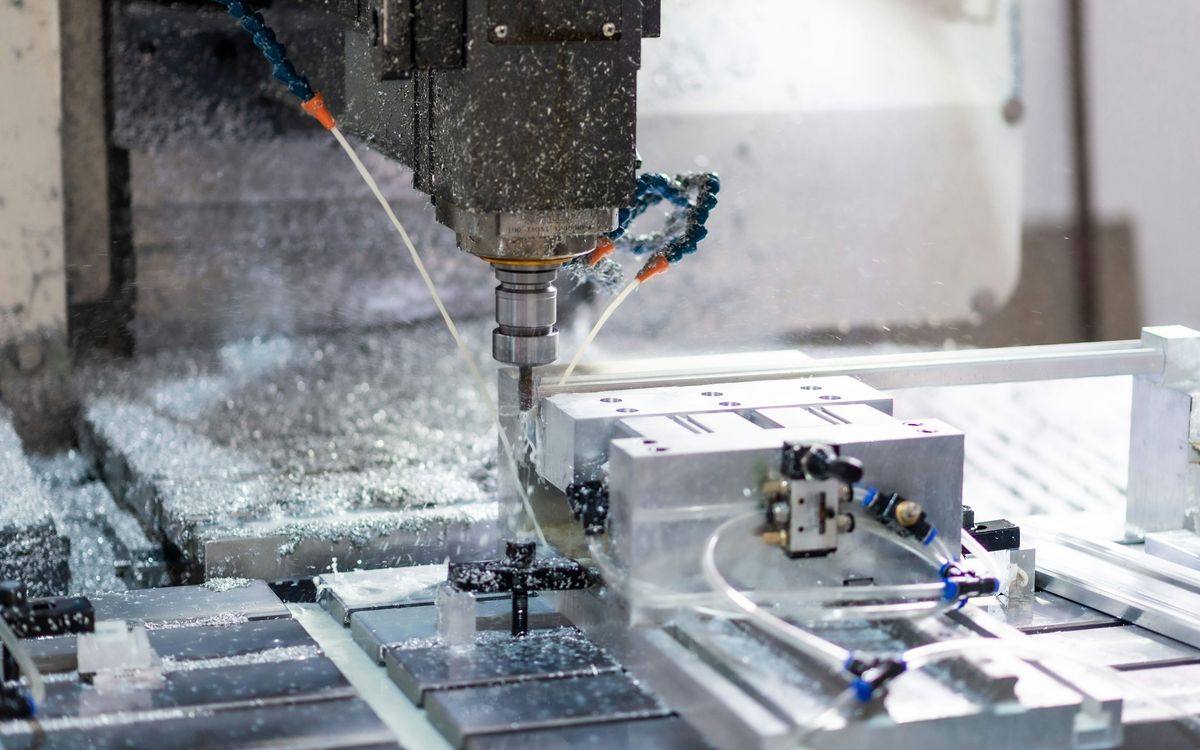
CNC machining is a manufacturing process in which a computer program controls a machine tool as it cuts material away from a solid block, bar or plate. CNC stands for computer numerical control. Because the program sets every tool path, spindle speed and feed rate, the machine makes the same part the same way every time.
This guide covers how a machined part is made, the main machine types and materials, what accuracy and cost to expect, and what CNC machinists earn.
The short version
- CNC machining is subtractive: it starts with more material than the part needs and cuts the rest away.
- A CAD model becomes tool paths in CAM software, and then G-code that the machine’s controller reads.
- Protolabs quotes ±0.005 in (about ±0.13 mm) as its standard machining tolerance. Tighter tolerances cost more because they take longer.
- For one-off parts, programming and setup usually cost more than the cutting.
- US machinists and tool and die makers earned a median of $59,620 in 2025, according to the Bureau of Labor Statistics.
How a CNC part gets made: from CAD to G-code
Every machined part, from a single prototype to a run of thousands, passes through the same stages:
- Design. An engineer models the part in CAD software and adds dimensions and tolerances to the drawing.
- Programming. CAM software turns the model into tool paths, and a post-processor converts them into the G-code dialect of a specific controller.
- Setup. The machinist clamps the stock in a vise, chuck or fixture, loads the cutting tools and measures where the part and each tool sit.
- Prove-out. The first run is slowed down or simulated to catch collisions and programming mistakes.
- Machining. The controller reads the program line by line and drives a motor on each axis.
- Inspection. Parts are checked with gauges, on-machine probes or a coordinate measuring machine (CMM).
Programming and setup are the stages that surprise first-time buyers. On a one-off part they often take longer than the cutting itself.
G-code: the instructions the controller reads
Most CNC controllers read G-code, a language of letter-and-number commands. Each control builder adds its own extensions, which is why CAM software needs a post-processor for every machine. A short milling program looks like this:
G90 G54            (absolute positioning, work offset 1)
T1 M06             (load tool 1)
S8000 M03          (spindle on clockwise at 8,000 rpm)
G00 X0 Y0 Z5.0     (rapid move above the part)
M08                (coolant on)
G01 Z-2.0 F300     (feed down 2 mm at 300 mm/min)
G01 X50.0          (cut a straight line)
G02 X60.0 Y10.0 R10.0  (cut a clockwise arc)
M05                (spindle stop)
G-codes control motion and modes, while M-codes switch functions such as the spindle and coolant. CAM software writes nearly all of this now. Machinists still read and edit it at the machine, though, so G-code remains part of every training program.
Types of CNC machines differ in what moves
| Machine | What moves | Typical parts | Typical materials |
|---|---|---|---|
| Mill or machining center | The tool spins; the workpiece is clamped to a moving table | Brackets, housings, plates, molds | Metals and plastics |
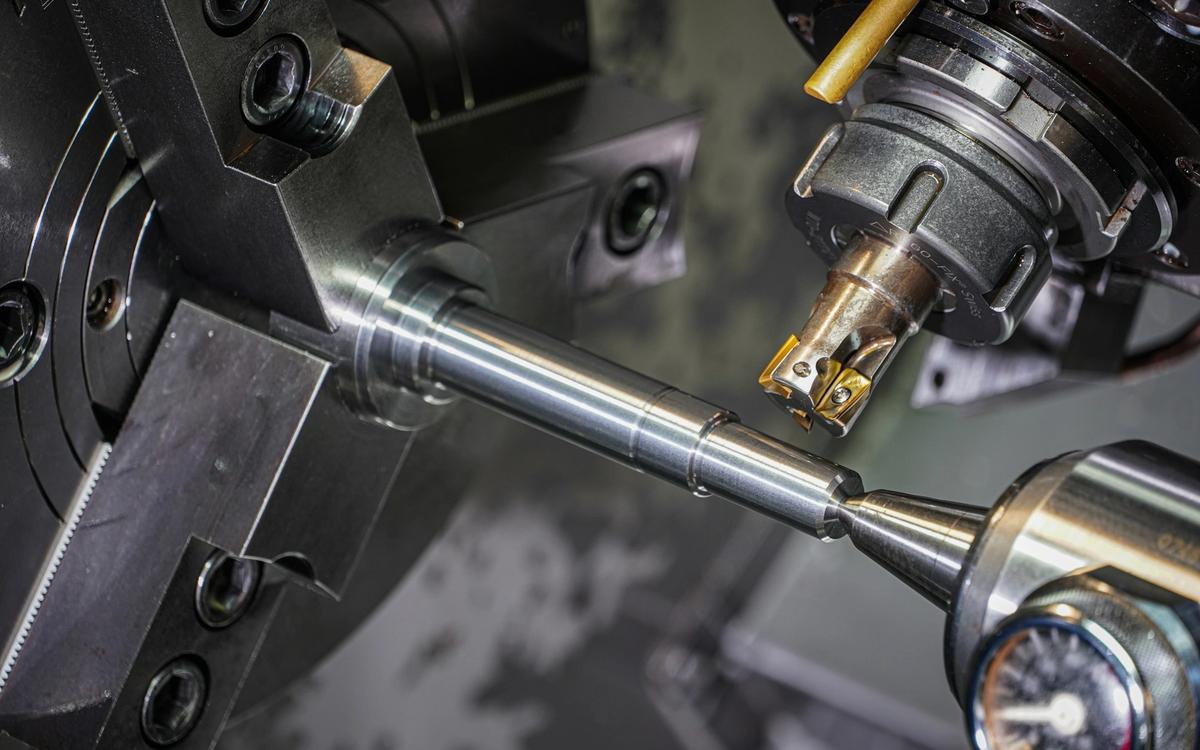
| Lathe or turning center | The workpiece spins; the tool is stationary | Shafts, pins, bushings, fittings | Metals and plastics |
| Swiss-type lathe | Bar stock slides through a guide bushing next to the tool | Long, thin parts such as bone screws | Metals |
| Router | A light gantry moves the spindle over a fixed sheet | Panels, signs, cabinet parts | Wood, plastics, composites, aluminum sheet |
| Grinder | An abrasive wheel removes small amounts of material | Hardened parts that need a fine finish | Hardened steel |
| EDM, laser, plasma, waterjet | Material is eroded by sparks, melted or cut by abrasive water | Dies, profiles, sheet parts | Mostly metals |
The last row is controlled by computer too, but those machines don’t cut chips. When machinists say “CNC machining” without qualification, they usually mean milling and turning.
On a mill, the axis count decides how many setups a part needs. A 3-axis machine moves the tool in X, Y and Z, so each new face of the part means re-clamping it. Adding two rotary axes lets a 5-axis machine reach most faces in one or two setups.
That saving explains why 5-axis machines are common in aerospace and medical work despite their higher hourly cost.
Lathes have picked up milling work as well. Many turning centers now carry live tools and a Y axis, so they can mill flats and drill cross holes without moving the part, and multitasking machines such as the Mazak QRX do both in one setup. At the small end of the market, desktop CNC machines have brought milling to hobbyists and prototype shops.
Aluminum cuts fast, titanium and Inconel do not
Most rigid materials can be machined. They differ in cutting speed, tool wear and how stable they stay while being cut.
| Material | Common grades | What to know |
|---|---|---|
| Aluminum | 6061, 7075 | Fast to cut; the default for prototypes and many production parts |
| Steel and stainless steel | 1018, 4140, 17-4 PH | Slower than aluminum; hardened steel often needs grinding or EDM |
| Titanium and nickel alloys | Ti-6Al-4V, Inconel 718 | Used in aerospace and medical parts; slow to cut and hard on tools |
| Brass and copper | C360 brass | Brass is among the easiest metals to machine |
| Plastics | Acetal (Delrin), PEEK, nylon | Move with heat and clamping pressure, so tight tolerances need care |
| Wood and composites | Hardwoods, MDF, carbon fiber | Usually cut on routers; carbon fiber dust needs extraction |
How accurate is CNC machining?
Accurate enough for most mechanical parts without special effort. Protolabs, a large online manufacturing service, quotes ±0.005 in (about ±0.13 mm) as its standard tolerance and ±0.002 in as a precision option. It can hold ±0.0005 in when a design calls for it, and its supplier network works to ISO 2768 general tolerances.
Each step tighter adds finishing passes and inspection time, and the tightest tolerances can need grinding.
So tight tolerances belong only on the features that mate with other parts. Putting ±0.0005 in on every dimension raises the price without making the part work any better.
Aerospace, medical and mold making rely on machined parts
Aerospace and defense suppliers machine structural brackets, engine parts and housings from aluminum, titanium and nickel alloys. Medical device makers turn bone screws and surgical instruments on Swiss-type lathes. Semiconductor equipment needs machined vacuum chambers and wafer-handling parts, and automotive and EV programs machine prototypes, tooling and motor housings.
Plastic parts depend on machining indirectly. The molds behind most injection-molded parts are CNC machined, with EDM for the finest details.
Where CNC machining fits, and where casting or 3D printing wins
Machining suits parts that need accuracy and the full strength of solid metal, in quantities from one to a few thousand. No mold or die is needed, so a simple aluminum part can go from CAD file to finished part in days. Once a program is proven, part 500 matches part 1 as long as tools and fixtures are maintained.
Its limits come from cutting. A rotating tool can’t reach enclosed internal channels or make perfectly sharp inside corners; additive manufacturing and EDM handle those shapes. Much of the starting block ends up as chips, which matters most with expensive alloys such as titanium.
Volume is the other limit. At high quantities, casting, forging, stamping or molding usually costs less per part.
Setup, not cutting, drives the cost of small batches
A machined part’s price comes from machine time, programming and setup, material, and whatever tolerances, finishes and inspection the drawing asks for. A 5-axis machining center bills more per hour than a 3-axis one, and nickel alloys cost more to buy and take longer to cut.
Programming and setup are paid once per job, whatever the quantity. Doubling an order therefore rarely doubles the price. If you expect to need 10 parts now and 50 later, ask for quotes at both quantities.
What CNC machinists do, and what they earn
A CNC machinist sets up and runs CNC machines, checks finished parts against the drawing, and adjusts offsets, tools and programs when parts drift out of tolerance. Larger shops split the work between operators who load parts, setup machinists who prepare new jobs, and programmers who write the CAM programs.
According to the Bureau of Labor Statistics, the 344,900 machinists and tool and die makers in the US earned a median of $59,620 a year ($28.66 an hour) in 2025. BLS projects employment to fall 1% between 2025 and 2035.
Pay tends to rise with programming, 5-axis and inspection skills, and in aerospace and medical shops. Company profiles in the CNC Outlook directory link to careers pages where employers publish them.
From punched tape to computer control
Modern CNC traces back to John T. Parsons, whose company in Traverse City, Michigan, made helicopter rotor blades. From 1946, Parsons and engineer Frank L. Stulen used computing methods to calculate the precise curves of those blades.
A 1948 contract for tapered aircraft wings pushed the idea further. MIT joined as a subcontractor for the servomechanisms and developed reliable servo control in 1952. That May, Parsons filed a patent for a “Motor Controlled Apparatus for Positioning Machine Tool”, granted in 1958 as US Patent 2,820,187.
Parsons and Stulen received the National Medal of Technology in 1985. By then, computers had replaced the punched-tape readers of early numerical control (NC) machines, and NC had become CNC.
Unattended running and AI programming are the next shifts
Robot loading and pallet systems let machines run overnight with nobody at the controls. Hamilton Caster uses robots to load its wheel machining, and Mazak demonstrated a 12-pallet cell built for the same purpose.
AI is reaching programming too, with limits. CAM vendors are adding AI assistants for routine work, such as GibbsCAM’s Copilot, and FANUC is bringing AI and digital twins to the control, but in both cases a programmer still approves what the machine does. Measurement is moving onto the machine at the same time, with on-machine probing and calibration such as DMG MORI’s ProbeSet.
How much of a programmer’s judgment these assistants can take over is still an open question.
FAQ
What is CNC machining good for?
Accurate, strong parts in metal or plastic, especially in volumes too low to justify a mold or die. Prototypes, aerospace and medical components, tooling and replacement parts are typical examples.
Can a CNC machinist make $100,000 a year?
Some do, but it is well above the 2025 BLS median. Six-figure incomes usually come with CNC programming, shop management, specialist 5-axis or Swiss-type work, regular overtime, or owning a shop.
Is CNC easy to learn?
Loading parts and running a proven program can be learned in weeks with supervision. Setting up new jobs, reading complex drawings and fixing parts that are out of tolerance takes years, usually through a community college program, an apprenticeship or on-the-job training.
Is CNC a lot of math?
Daily work uses arithmetic, decimals and basic trigonometry for angles and hole patterns, plus a solid grasp of tolerances. CAM software handles the complex geometry, but machinists need enough math to spot when a program or a measurement is wrong.
Is 3D printing replacing CNC machining?
No. The two are increasingly used together: printing builds shapes a cutter can’t reach, and machining finishes the surfaces and holes that must be precise.