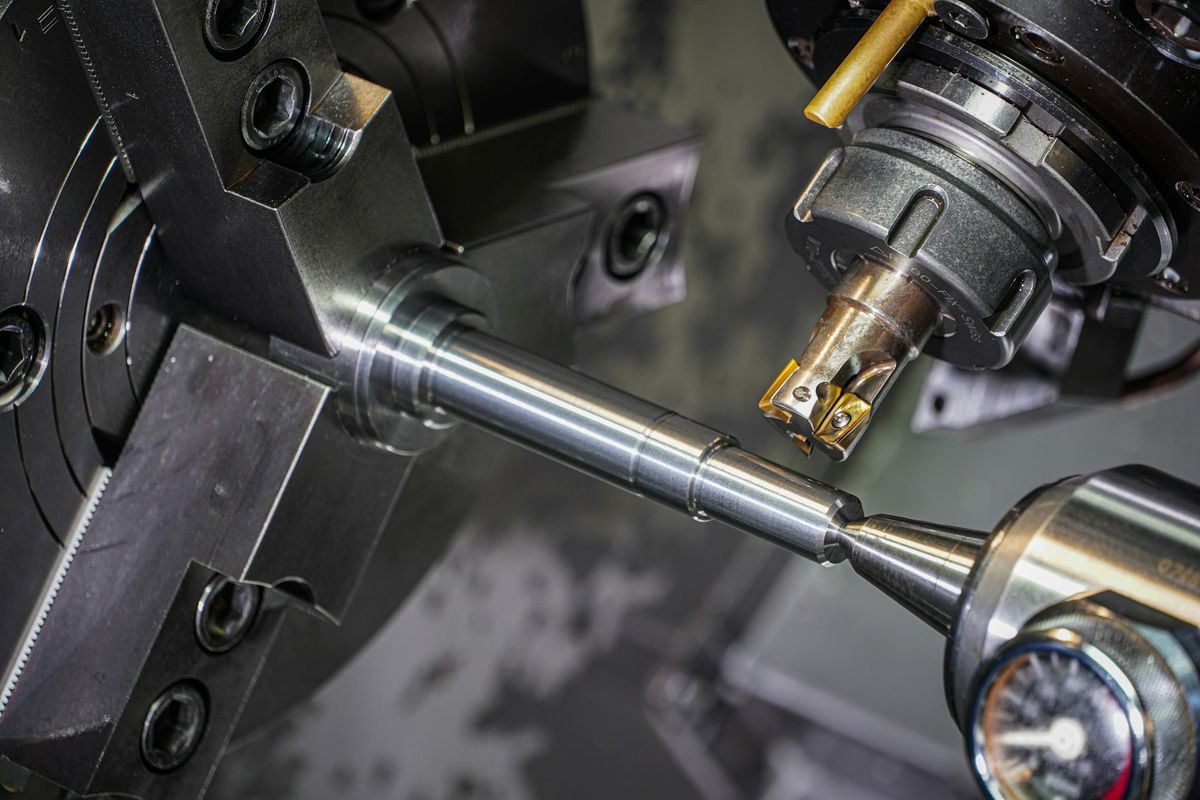
Ductile cast iron can be demanding on a turning insert because abrasive wear combines with the risk of chipping at changes in the cut. Tungaloy has introduced two chemical-vapor-deposition (CVD) coated carbide grades for it: T505D for higher-speed operations where wear resistance is the priority, and T515D as the general-purpose choice where interruption and edge fracture matter more.
The Japanese cutting-tool manufacturer posted the announcement on November 2, 2026. Its existing T500 grades cover gray cast iron; the new D-suffix T500D grades are specified for ductile iron, including FCD and GGG materials. The material classification affects cutting behavior and insert selection, so the two families are not automatically interchangeable.
A thicker alumina layer targets wear and chipping
Tungaloy says its T500D coating uses a fine columnar alumina (Al₂O₃) layer that is 1.4 times thicker than on the prior grade, a total coating thickness 1.3 times greater and an adhesion layer twice as thick. The total includes a continuous columnar titanium carbonitride (TiCN) layer. These are supplier-described relative dimensions; the release gives no absolute thicknesses or cross-section test.
The stated intention is to resist flank wear, built-up material and edge chipping while maintaining adhesion between coating layers. The company also applies its PremiumTec surface treatment to smooth the insert. Surface treatment and coating architecture can influence chip contact and edge integrity, but no single coating detail proves a tool-life advantage across every ductile-iron composition and interrupted cut.
The manufacturer's T500D product matrix places T505D in the ISO K05–K15 range and T515D in K10–K20. Those are grade-selection bands, not cutting-speed recommendations.
Manufacturer tests report 1.4 times the life under stated conditions
In its promotional comparison, Tungaloy reports a tool-life result exceeding 1.4 times that of the prior grade, using a CNMG120408 insert at 200 m/min cutting speed, 0.3 mm/rev feed and 1.5 mm depth of cut, with coolant and continuous cutting.
A separate interrupted-cut condition uses 150 m/min, 0.35 mm/rev and the same depth. It is offered as evidence of T515D's fracture resistance, not as a quantified universal life gain.
Additional manufacturer success reports describe T505D lasting 2.5 times as long as an unnamed competing grade on FCD400/GGG40 automotive parts at 300 m/min, and T515D lasting twice as long as a competitor on clutch components. The public summaries give no sample count, complete failure criterion or enough competitor specifications to predict the same ratios in another shop.
The test conditions should not be copied directly into a lathe program without checking insert geometry, machine power, workholding, material condition and Tungaloy's application data. Even two batches identified as ductile iron can differ in microstructure and interrupted-surface severity. The practical question is which edge failure mode causes most unplanned stoppages in the existing process.
Tungaloy says it has also widened its established gray-iron T500 insert lineup, which together with the two new grades gives buyers a broader selection across continuous and interrupted cast-iron turning.
Shops running ductile-iron turning cells can assess the claim by documenting baseline tool life, insert grade, wear pattern and actual cutting conditions before changing grades. A credible productivity result will come from that local comparison.