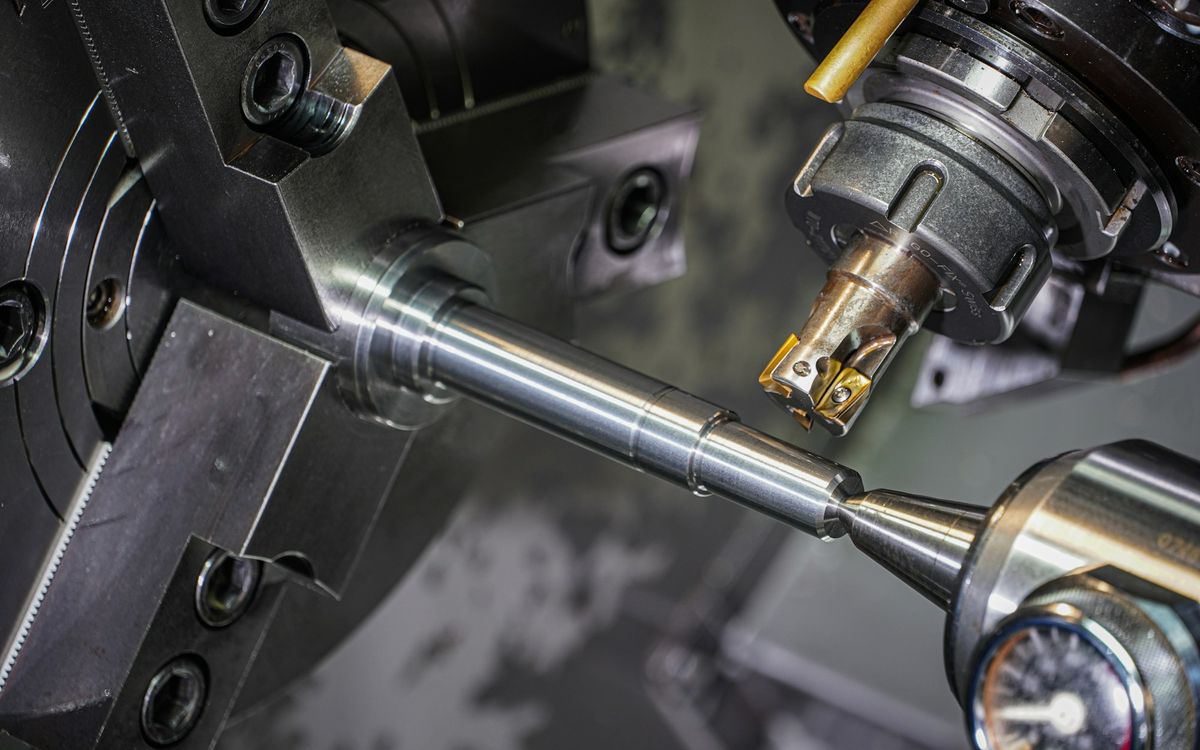
Deep-hole drilling often fails because the cutting edge cannot be supplied with enough coolant and the chips cannot leave a long, narrow hole reliably. Tungaloy's Fine-BeamJet, announced on November 2, 2026, takes a manufacturing approach to that problem: the body of its exchangeable BTA deep-hole drill head is additively manufactured so the coolant passages can curve around other features rather than follow only straight bores.
The series is offered in diameters from 25 to 33 mm, with versions for both single-tube (STS) and double-tube (DTS) coolant-supply systems. That matters because the machine's drilling system determines how coolant reaches the head and how chips return; an STS head is not simply a drop-in substitute for a DTS arrangement.
The original Tungaloy announcement presents the new body geometry as a way to increase useful flow while retaining rigidity, particularly around 30 mm diameter.
Coolant has to squeeze past the head's own geometry
In conventional BTA deep-hole drilling, coolant must reach the tool's cutting area across limited annular clearance and through passages constrained by the surrounding head geometry.
It must also protect guide pads as they stabilize the drill against the hole wall. Narrow supply routes raise the risk that heat and chips disrupt cutting, even when the pump delivers enough pressure upstream.
Straight bores are relatively easy to produce by traditional drilling. A complex curved passage, however, may be hard or impossible to machine once the drill body has been assembled. Additive manufacturing changes which internal shapes can be produced, allowing the designer to route a passage through available metal rather than remove it only along a straight line.
Tungaloy says the Fine-BeamJet layout uses irregularly shaped and curved passages to improve flow toward the cutting edges and guide pads. The product statement does not supply a comparative flow-rate graph, pump-pressure setting, coolant viscosity or independent thermal measurement. The claim of better evacuation therefore remains an attributed engineering rationale rather than a proven universal result.
A controlled application test, not a general guarantee
The manufacturer reports a 25% improvement in tool life compared with a conventional tool in one customer-success comparison. The listed application is deep-hole drilling of a duplex stainless-steel billet on a BTA machine.
The public report identifies the material family and machine class but does not provide the complete competing drill specification, cutting speed, feed, drilled length, fluid delivery parameters or repeatability across several tests.
The result is notable because duplex stainless steel can generate substantial heat and demanding chip-control conditions during drilling, but it does not show that a 25% tool-life gain will apply to every diameter or workpiece material. A defensible shop-floor comparison would have to record the hole geometry, wear limit, chip evacuation behavior, coolant conditions and the number of holes completed before tool replacement.
Tungaloy also credits increased drill-body hardness with improved deformation resistance and longer body life. Hardness is not the same as toughness, and a harder body alone does not guarantee better hole straightness, guide-pad survival or surface finish. The release does not provide enough independent material or hole-geometry inspection data to make those additional claims.
Fine-BeamJet is an example of additive manufacturing being applied to the cutting-tool body rather than the finished workpiece. The design freedom is inside the coolant network, where a standard external shape can conceal passages that would be difficult to machine.
The application still demands appropriate coolant capacity and a compatible deep-hole drilling machine. The announcement does not list prices, all head/insert combinations or delivery dates by region.
For manufacturers producing drive shafts, hydraulic components or heat-exchanger parts, the immediate evaluation question is whether the reported flow benefit holds in their specific STS/DTS system. The verified launch is the 25–33 mm additive-channel head range; the cycle-time and tool-life benefit remains to be established in a controlled local trial.