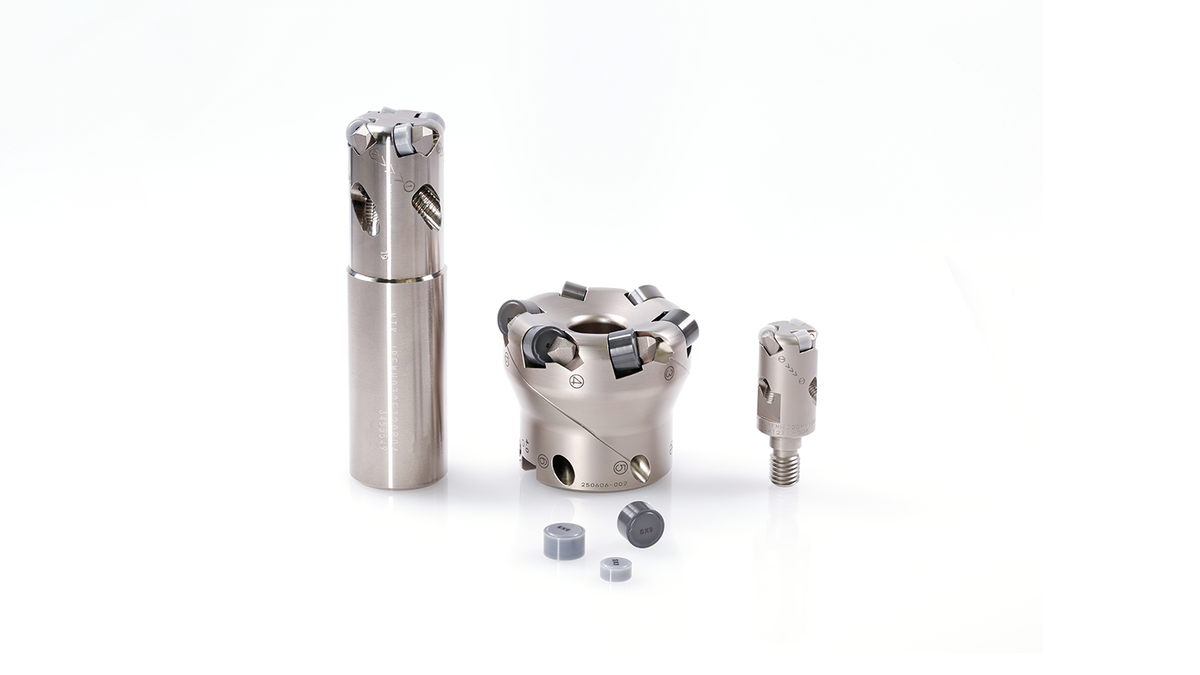
NTK Cutting Tools, based in Komaki, Japan, added two bore-type cutters to its JRF line on November 10, at 50 mm and 63 mm diameter. The announcement positions them for nickel-based alloys, including on machining centers with limited spindle speed.
The JRF series mills with ceramic inserts that carry several cutting edges on a negative-geometry design. NTK's JRF brochure lists SiAlON grades SX3 and SX9, modular heads from 16 to 32 mm, and the two bore-type sizes, coded JRFMH050S220R05 and JRFMH063S220R06. The brochure gives the bore-type cutters five or six edges and a maximum depth of cut of 1.0 mm.
Why diameter matters on a slower spindle
Ceramic milling of heat-resistant alloys runs far above carbide speeds. The brochure recommends 600 to 1,000 m/min for SX3 and 400 to 800 m/min for SX9 in milling superalloys. Surface speed depends on diameter and spindle speed, so a larger cutter reaches those figures at lower rpm.
Working from NTK's numbers, CNC Outlook's arithmetic puts 600 m/min at roughly 3,000 rpm on the 63 mm cutter and 3,800 rpm on the 50 mm. The brochure's 990 m/min example needs about 5,000 rpm and 6,300 rpm respectively. Those spindle speeds are far below what small-diameter ceramic tools require for the same surface speed, which is the case NTK makes for the larger bodies.
NTK says the extra edges spread wear, which may extend tool life and reduce tool changes. The brochure also reports speeds about 20 times those of a coated carbide solid end mill in Inconel 718 (990 versus 50 m/min). Both are manufacturer claims for the family, and the announcement provides no test data for the new sizes.
Insert tolerances and pocket geometry are not given in the announcement, and the 1.0 mm depth limit points to light passes, so buyers will want the eCatalog data and a trial on their own alloy and fixture rigidity before changing a roughing strategy.