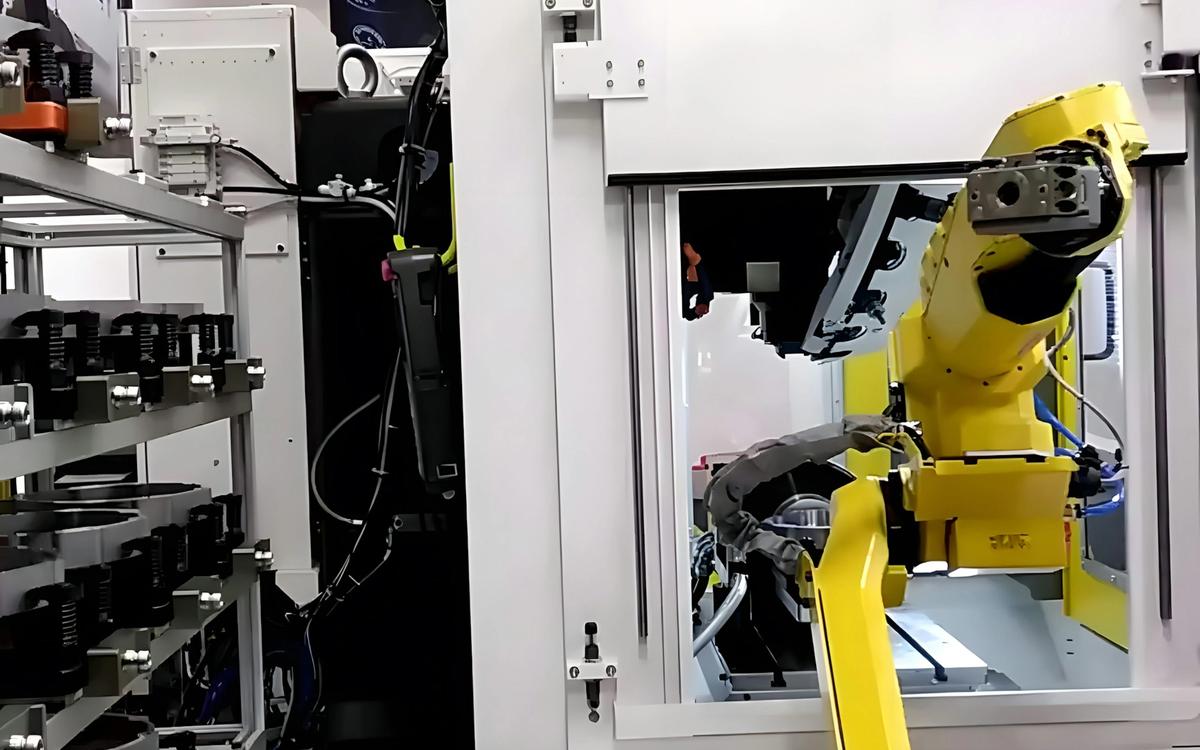
Nine of the 11 CNC machine tools in Okuma America's IMTS 2026 display were paired with automation. That ratio made a clearer statement about the company's strategy than any individual machine launch.
At the Chicago exhibition, held September 14–19, Okuma presented four machines making their Americas debut alongside pallet changers, robot loaders, CNC controls and related production equipment. Its July 24 programme announcement laid out the lineup; post-show reporting confirmed the emphasis on integrated machining cells.
The display reflected two different routes to unattended production. Some components can be queued on prepared pallets while machining continues. Others are better suited to automatic loading and unloading by a robot or gantry. Neither arrangement is inherently more efficient; the decision turns on part mix, fixture preparation, cycle duration and how reliably the process can recover when a tool or workpiece causes a stop.
Four Americas debuts, with different roles on the shop floor
Okuma's official machine and automation lineup identified four new-to-the-Americas models. They serve distinct production needs rather than representing a single platform:
- The MB-100V is a bridge-style vertical machining center intended for larger workpieces. Its value proposition differs from a compact horizontal cell where rapid pallet exchange may be the priority.
- The GENOS M4000H-e horizontal machining center appeared with an internal two-station automatic pallet changer, allowing one pallet to be prepared while the other is in the machine.
- The MS-320H horizontal machining center was paired with Okuma's updated Robot Loader Drawer II, bringing automated workpiece presentation into a smaller machining-cell arrangement.
- The MULTUS U1000 is a multitasking turning and milling machine. Its inclusion showed a process-consolidation route that is distinct from automated part loading.
The most conspicuous pallet system was not attached to a debuting model. Okuma showed its new two-level, 13-pallet Tower Pallet Changer with the established MB-5000HII horizontal machining center. That distinction matters when interpreting photographs or exhibition coverage: the introduction of a pallet system should not be confused with the introduction of the machine carrying it.
On other stands and in product literature, an automatic pallet changer can mean a two-pallet exchange mechanism or a larger pool holding many fixtures. The operational benefits differ.
A simple changer can hide loading time for one prepared pallet; a pallet pool can queue several jobs, but asks more of scheduling, tool management and identification of each pallet. The right number of pallets depends on how long each job runs and whether skilled staff can keep the pool prepared.
Control, loading and recovery must operate as one system
Okuma also placed its OSP-P500 CNC on nine machines and made interactive control simulators available. The integration problem is broader than opening a machine door at the end of a cycle.
An automated cell must coordinate program selection, work offsets, chuck or fixture confirmation, workpiece handling and alarms. In a high-mix shop, the control strategy must also protect against starting the right program on the wrong pallet or part.
The manufacturer's equipment list included several forms of loading: drawer-based robots, a robot loader for machining centers, a gantry loader, and automatic unloading with bar feeding on a lathe. Those approaches have different strengths. Bar-fed turning suits repeatable blanks; a robot can manage discrete pieces; pallet handling preserves pre-set fixturing for different machining jobs. A production engineer assessing the show should keep those differences separate rather than assuming all automation produces the same unattended hours.
Okuma's planned display also featured an AI-focused robot cell with Intrinsic and the OHP-C8 high-pressure coolant system.
The presence of a demonstration is evidence of the supplier's technology direction, not proof of a factory-qualified process or a measurable return on investment. For extended unattended work, chip evacuation, tool breakage monitoring, part removal and the cell's response to a failed measurement can matter more than a faster nominal cutting cycle.
What a trade-show cell cannot establish
A useful comparison between alternative cells would measure a complete sequence of accepted components, including loading, cutting, tool changes and recovery after interruptions. A show-floor cycle demonstrates equipment functioning under prepared conditions. It does not reveal how much engineering a buyer will need to handle its own materials, fixtures or production variability.
IMTS 2026 therefore presented Okuma as a supplier of connected machining processes, not merely individual machine tools. The four Americas debuts expanded the equipment lineup, but the distinction with the clearest operational consequence was the range of ways workpieces could be kept moving between machining cycles.