DMG MORI is holding its 2026 revenue and profit forecasts even though it raised its order outlook, and its president has said supplier delays are disrupting shipments of some machines due in the fourth quarter.
The remarks came at the company's online briefing on October 30 and were reported by MONOist on November 5. They add an operating constraint to the order-book figures in CNC Outlook's earlier report on the results.
President Masahiko Mori said some machines scheduled to ship in the fourth quarter are affected by late component deliveries from suppliers. The company lifted its full-year consolidated order forecast from ¥630 billion to more than ¥650 billion but left its revenue and EBIT forecasts as they were. The report does not name the components or suppliers involved and gives no figure for the shipments affected.
Order growth is expected to reach revenue mainly in 2027 and 2028
Orders are arriving faster than DMG MORI expected, and more of them are long-lead projects. The company therefore expects the current order growth to reach revenue mainly in the second half of 2027 and in 2028, and is targeting 2027 revenue of ¥630 billion and EBIT of ¥51 billion.
Third-quarter orders alone were ¥186.8 billion, up 40.1% and a third consecutive quarterly record, with the machine backlog at ¥328 billion on September 30.
Mori also offered a personal view of the cycle: orders have been recovering for about two years since a low in the fourth quarter of 2024, and he expects the recovery to last through the third quarter of 2027. That is the president's judgment, not company guidance.
Where the ¥48 billion share offering goes
In August, DMG MORI raised about ¥48 billion through an overseas public offering. Roughly ¥15 billion is earmarked to merge the Nagaoka, Niigata operations of group companies Taiyo Koki and DMG MORI Precision Boring, formerly Kurashiki Kikai, into a new plant, and about ¥3 billion to expand in-house production of key components. Another ¥10 billion is set aside as part of future acquisition funding.
The largest overseas items are in Europe and the United States. About ¥14 billion goes to a foundry in Poland, DMG MORI CASTECH Poland, meant to bring in-house castings now sourced from China and India. With the Japanese DMG MORI Castech as its mother factory, it is targeted for full operation in 2030 with capacity of 20,000 tonnes a year, enough for about two-thirds of the castings used in Europe.
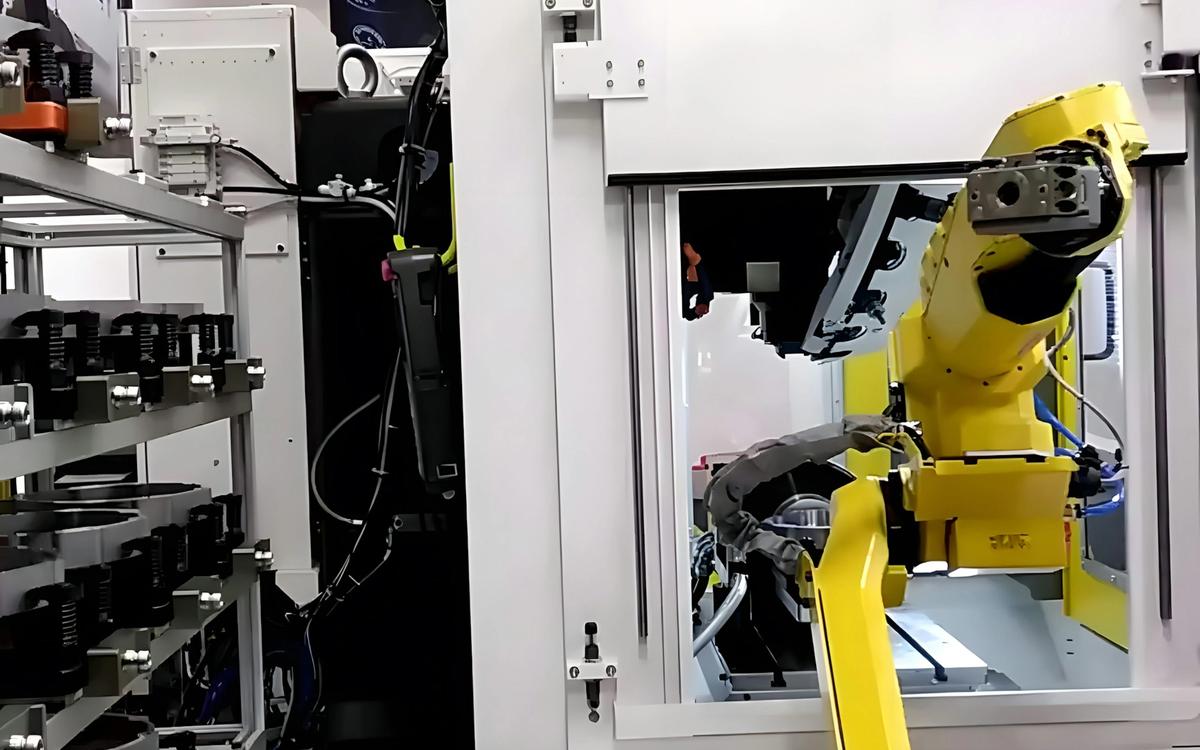
About ¥6 billion funds a new Americas headquarters and R&D center in Chicago, planned to house about ten powder-bed metal additive-manufacturing machines. The GX Flex gantry-loader robot shown at JIMTOF 2026 is to be installed at the Iga plant for spindle machining.
The spending aims to reduce dependence on outside supply of castings and key components, but MONOist's report does not say which parts are late, and nothing funded here can help fourth-quarter 2026 shipments: the Polish foundry is a 2030 project. Which suppliers are behind, and for how long, are the open questions behind the unchanged revenue forecast.